What Holiday Shopping Can Teach Multifamily Marketers About Their Renters
Holiday shoppers check stock and price before they ever leave home. Renters expect the same, but most portfolios still make them shop six stores for one list.
By Gunnar Blakeway-Walen · Published November 23, 2026 · 5 minute read
In this Article
Never Miss a Resource
The short version
Holiday shoppers check price and stock online before they make the trip, and they go elsewhere when the item isn’t there.
Renters shop the same way, but most portfolios still give them one website per property. That sends them back to listing sites and search ads you pay for.
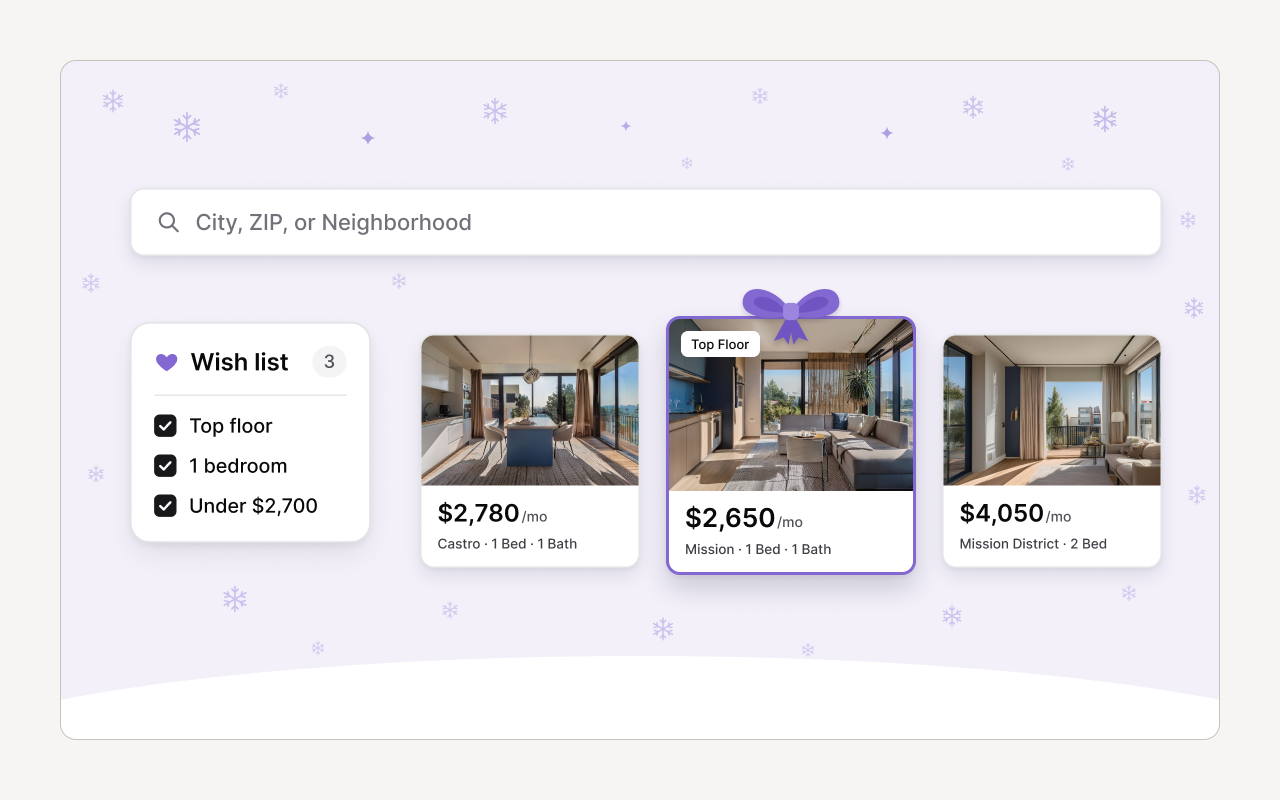
A Centralized Leasing Site puts every community and actually available unit in one search on your own domain. Before your 2027 budget goes out the door, ask how many separate shopping trips it’s funding.
Six stores, one gift list: shoppers check before they go
You know the errand. A list in one hand, keys in the other, and six shops across town. The gift you wanted was at store four, after you’d already settled at store two.
Shoppers still make the trip, but they do their homework first. More than half of US shoppers check four or more channels before they buy, according to a 2026 Salsify survey.1 And most of the list never requires a trip: shoppers plan to put 55% of their holiday budgets online this year, according to Deloitte.2
They want proof it’s in stock, too. Three in four tell Forrester it’s important for a store to show in-store availability on its website.3 When the item isn’t there, two in three shoppers go to another retailer instead.4
Shoppers bring that habit to the biggest purchase most of them make all year: where they live.
Renters shop the same way, but your sites send them store to store
Renters shop a neighborhood, not a building. In a national survey published this year, 87% of renters started looking without a specific property in mind.5 Among renters in buildings with 50 or more units, 85% call their preferred neighborhood essential.6
They rarely shop alone, either. Three in four recent renters bring someone along, like a partner, roommate, or family member, so there’s more than one name on the list.6
Renters shop the neighborhood, not the building
Share of renters
Started looking with no specific property in mind
87%
Call their preferred neighborhood essential (buildings with 50+ units)
85%
Brought someone else along on the search
75%
Every one of these renters is shopping more than one of your buildings, whether your websites let them or not.5,6
Most portfolios make apartment hunting harder than it needs to be. Each community has its own website, its own search, and its own version of what’s available. A renter who loves the neighborhood but not the floor plan at one property has no easy way to find your other property three blocks over. Every property site is a separate store, and the renter does the driving.
Multifamily hasn’t caught up because portfolios grow one acquisition at a time, and the website stack grows with them. The data stays split up too: in a survey of 301 multifamily executives, 70% named data quality and visibility as their top barrier to centralizing.7 The listing sites stepped in and built the market-wide search renters wanted.
You’re paying for every extra trip: higher leasing costs and duplicate ad spend
Leasing a unit costs more every year. Leasing expenses reached $292 per unit, up 4.6%, in the National Apartment Association’s latest national benchmark, and concessions jumped almost 31%.8
Part of that cost is self-inflicted. When a renter hits a dead end at one of your properties, they rarely come back to your corporate site to browse. They go back to search and often land on a listing site that shows your competitor right next to you.
Paid search adds to the bill. When every property runs its own campaigns, your portfolio buys the same local searches several times over, in separate budgets and often through separate vendors. If those campaigns sit in different ad accounts, your own properties can end up in the same auction.9
One trip: what a Centralized Leasing Site changes
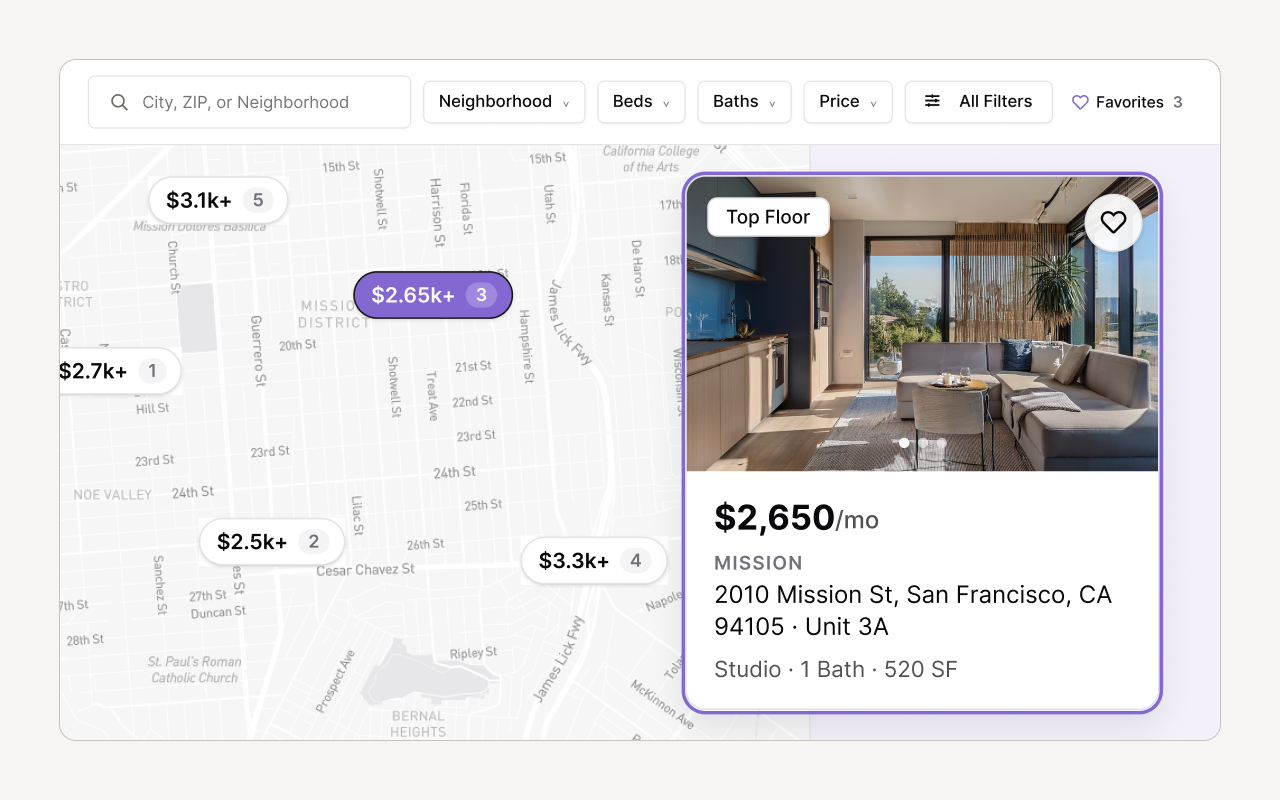
A Centralized Leasing Site puts every community and every available unit in your portfolio in one search, on your own domain. Renters can:
Search by neighborhood, price, move-in date, and floor plan across all your properties at once
See each unit’s all-in monthly price, built automatically building by building, with the fee display required in whatever state you operate in
See which units are actually available, synced from your property management system, instead of “call for availability”
Save favorites, compare units, and book a tour without leaving your site
Showing the all-in price up front keeps your property on the renter’s list. In online retail, surprise costs are the top reason shoppers abandon a checkout: 40% of US shoppers who left one blamed extra costs like shipping, taxes, and fees, according to the Baymard Institute.10 Renters are no different. In that national renter survey, 54% said they’d cross a property off their list if last-minute fees pushed the price above what was advertised.5
For your team, one Centralized Leasing Site means:
One place to send every search ad in a market
One renter experience to manage
One view of which channels turned into leases
It also matches how operators already work behind the scenes. In that executive survey, 69% have centralized at least part of their operations, and two-thirds of those have centralized leasing.7 A Centralized Leasing Site gives renters a front door that matches.
The 2027 question: how many shopping trips are you funding?
The next renter may not start with a search engine at all. 78% of recent renters use AI at least occasionally, and more than half of those who used it in their search asked it to recommend homes.6 Right now, those answers mostly point to listing sites. In Peek’s 2026 study of how AI tools recommend apartments, 72% of AI citations came from listing sites.11
Where AI answers about apartments point
Share of citations across renter-style prompts in four AI models
72%Listing sites
28%All other sources
Today, most AI answers send renters to someone else’s storefront.11
AI tools also hold back when the facts look shaky: Bing’s search team writes that when supporting information is “missing, stale, or conflicting,” an AI system may choose not to answer at all.12 A site that keeps every available unit, its all-in price, and a page for each community current gives those tools something accurate to cite, on your own domain.
Your 2027 budget is unwrapped. How it gets spent isn’t. So ask one question before the money goes out: how many separate shopping trips are you funding? Next year, give your renters one place to shop.
Sources
Salsify, 2026 Consumer Research, published January 21, 2026. 2,712 shoppers in the US, Canada and UK (908 US), fielded October 2025.
Deloitte, 2026 Holiday Retail Survey, published October 15, 2026. 4,000 US consumers, fielded August 26 to September 10, 2026.
Forrester, Consumer Pulse, published January 3, 2025. US online adults, fielded May 2024.
AlixPartners, Consumer Sentiment Index 2024, published October 24, 2024. 9,000+ US consumers, fielded June 28 to July 2, 2024.
National renter search survey, published February 21, 2026. 15,000+ US adults planning to rent, fielded November to December 2025.
Yes. Online search narrows the list, and the tour confirms the choice. Renters just want to book it the way they shop everything else: nearly half prefer to schedule tours online over any other method. On a Centralized Leasing Site, renters can book a tour right from the unit they picked.
It gives every campaign in a market one destination. Today each property usually advertises its own website, so the same renter search gets paid for several times, and properties in separate ad accounts can bid against each other. With one site, one campaign can show renters every available unit you have nearby, and a renter who passes on one community sees your other options before a competitor’s.
Count how many places a renter has to look: how many property websites you maintain, how many listing-site contracts renew next year, and how many search campaigns target the same markets. That total is a good place to start a January conversation.
Built for multifamily, not adapted for it.
Property websites, content, integrations and analytics in one platform.